The best Skedda alternatives are:
- Ronspot
- Deskbird
- Robin
- Kadence
- OfficeRnD
- Tactic
- Envoy
- YAROOMS
Skedda earns its reputation. The floor plan editor is genuinely good. The rules engine is flexible enough to configure time-window logic, booking limits and approval flows without professional services. And because it charges per space rather than per user, growing your headcount does not automatically grow your bill — a structural advantage that makes it attractive for organisations adding employees faster than they are adding desks.
The platform ceiling, though, is real. It shows up at a predictable set of moments: when a facilities manager asks “what percentage of our floor is actually being used, not just booked?”; when employees start finding unoccupied parking spots that were claimed but never confirmed; when the IT team requests SSO and realises it requires upgrading to the Premier tier; when HR needs to reconcile attendance data with bookings and there is no automatic check-in to bridge the gap. At those moments, the thing that made Skedda easy to start — its deliberate simplicity — becomes the reason to look elsewhere.
This list covers the eight platforms most worth evaluating when Skedda’s ceiling is the issue. The alternatives here are not necessarily more complex. Some are simpler. What they all offer is something specific that Skedda has structurally chosen not to build.
6 signs your team has outgrown Skedda
1. You cannot tell the difference between bookings and actual occupancy
Skedda shows you what was reserved. It does not show you whether people showed up. For organisations where ghost bookings are consuming capacity, booked desks or parking that nobody uses, a booking system without check-in data cannot solve the problem.
2. Parking is managed through a separate tool or spreadsheet
Skedda can add parking spaces as bookable resources, but it has no credit-based allocation, no waitlist logic for high-demand spots, and no way to auto-release an unconfirmed booking. Teams with more employees than parking spots quickly hit this wall.
3. The occupancy data does not support a real estate decision
According to the 2026 workplace statistics report, 81% of organisations now cite space optimisation as their primary hybrid programme goal — and the data they need to act on that is not “what was booked” but “what was used, by whom, by floor, by zone, over time.” Skedda’s insights dashboard does not produce that depth.
4. SSO is a requirement and you are on the Starter or Plus plan
Skedda gates SSO to its Premier tier. In enterprises where SSO is a non-negotiable for IT approval, the pricing conversation changes significantly.
5. You need visitor check-in alongside desk booking
Skedda does not have a native visitor management module. Organisations that manage client visits, candidate interviews or external contractor access alongside employee bookings end up with two separate systems.
6. You are rolling out across multiple sites and need central reporting
Skedda’s multi-location support exists, but the reporting layer does not aggregate across sites with the zone-level and floor-level granularity that facilities directors need for a consolidated view.
The 8 best Skedda alternatives in 2026
1. Ronspot
Skedda handles the booking act well. Ronspot was built for everything that comes after the booking — the check-in, the occupancy data, the parking allocation, the floor-level analytics, and the operational rules that reduce admin without adding configuration complexity.
The most significant structural difference is the resource scope. Skedda treats parking as a type of bookable space; Ronspot has a dedicated parking management engine. That distinction produces different outcomes: Skedda can hold a reservation for a parking spot, but it cannot automatically release that spot when someone does not check in, distribute spots by team credit allocation, or surface a list of frequent no-shows to the admin. The credit-based parking system in Ronspot does all three, and the Wi-Fi check-in closes the loop between what was reserved and who actually arrived.
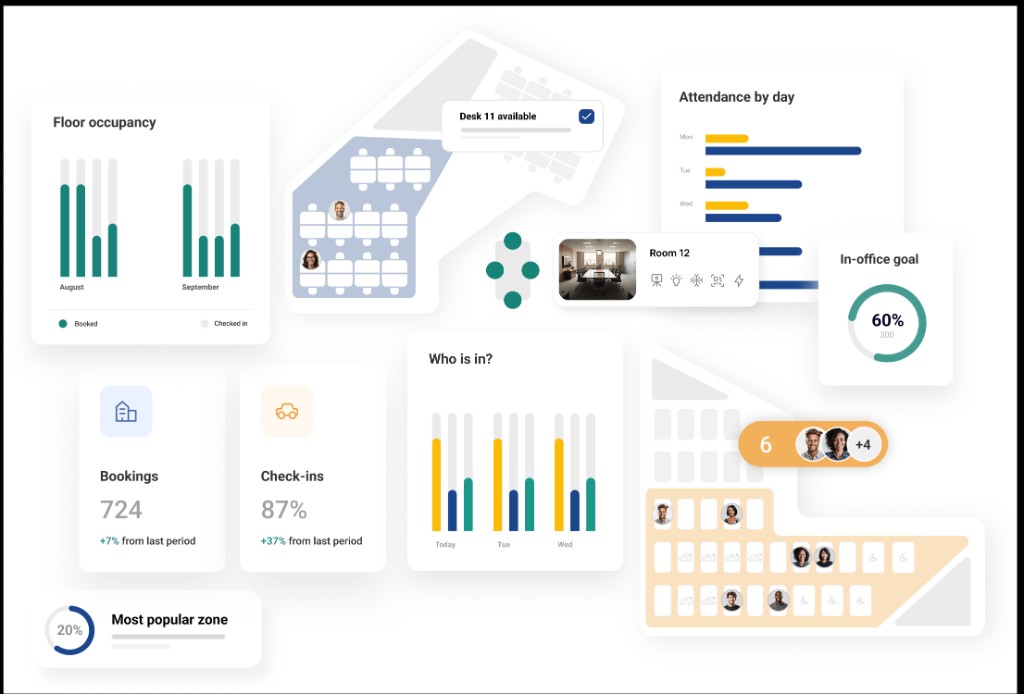
On analytics, the gap is equally meaningful. Skedda’s Starter tier has a limited insights dashboard; the full dashboard requires Plus or Premier. Ronspot’s occupancy data, collected through automatic check-in rather than manual confirmation, tracks actual utilisation at zone and floor level. For the conversation with finance about whether the company can reduce its lease footprint, that data holds up. The 2026 workplace statistics report shows that 52% of organisations use reservation systems for utilisation tracking, and 56% plan to add sensor or Wi-Fi analytics in 2026. The difference between “we have booking data” and “we have utilisation data” is the difference between those two groups.
Ronspot also maintains ISO 27001 certification continuously since 2020, five years. For IT approval processes where security documentation is required, this is the comparable credential that Skedda does not hold. And where Skedda’s simplicity means limited automation, Ronspot’s 18 built-in workplace automations handle the operational layer — auto-release, waitlists, booking on behalf of others, desk and parking booking priority rules, without adding configuration overhead.
2. Deskbird
Where Skedda is built around the space, Deskbird is built around the employee. The booking interface is optimised for how people actually plan their week: seeing which teammates are coming in before choosing a desk, not the other way around. That difference matters for adoption — particularly for teams that are experiencing low engagement with the booking step rather than a problem with the booking engine itself.
Deskbird also integrates more deeply with HR systems than Skedda does, which matters for organisations that want booking data to connect with absence management, headcount planning or hybrid policy compliance. The mobile app is consistently rated as among the most intuitive in this category — the three-tap booking flow is designed for the phone, not adapted from a desktop experience.
The trade-off relative to Ronspot is parking management depth and enterprise security credentials. Deskbird does not have a native parking module at the same depth, and its security documentation does not include the same ISO 27001 track record. For teams where the primary problem is employee adoption rather than operational resource management, Deskbird is the right answer.
3. Robin
Robin operates at the scale and complexity that Skedda is not designed for: enterprise real estate, physical sensor integrations, hardware displays at room doors and desks, and an analytics layer that informs lease negotiations, not just daily operations.
The practical comparison is clear: Skedda offers an insights dashboard. Robin offers an occupancy intelligence platform. The former shows you booking patterns. The latter shows you actual sensor-verified presence data that a Head of Real Estate can bring to a renegotiation. For organisations where the facilities team has been asked to justify the existing space footprint with data, Robin’s analytics layer is built for that conversation.
The trade-off is implementation time and cost. Robin deployments typically involve professional services and a longer configuration period. Teams that have outgrown Skedda’s simplicity but are not ready for Robin’s complexity often land at Ronspot as an intermediate step.
4. Kadence
Kadence addresses a problem Skedda does not acknowledge: that many employees do not use a desk booking system because they are not sure whether going into the office is worth it on any given day. Kadence makes the coordination layer visible — showing who from the team is planning to come in before a booking is made.
This is a fundamentally different design assumption than Skedda. Skedda assumes the decision to come in has already been made and presents available spaces. Kadence helps employees make the decision by surfacing social context first. According to the 2026 workplace statistics, 92% of employees cite collaboration and community as the main reasons for returning to the office — Kadence is built around exactly that motivation, where Skedda is built around the mechanics of space reservation.
For organisations where the symptom is “our booking platform exists and employees are ignoring it,” Kadence addresses the root cause. For organisations where the symptom is “we need better data on what spaces are actually being used,” it does not.
5. OfficeRnD
OfficeRnD comes from a different origin than Skedda. Where Skedda was built for general space management across any type of venue, OfficeRnD was built for coworking operators — organisations managing complex access rules, member tiers, external tenants and billing alongside internal bookings.
That background gives it a specific strength for corporate organisations managing mixed-use real estate: floors shared with external tenants, spaces rented out to contractors, or buildings where multiple business units need distinct access logic. Skedda’s rules engine is configurable for these scenarios, but OfficeRnD’s access model was designed for this complexity as the default rather than as an edge case.
The billing and membership management features — OfficeRnD’s coworking roots — are also relevant for organisations that charge back space usage to cost centres or business units, a common requirement in larger corporate real estate structures that Skedda handles only partially.
6. Tactic
Tactic’s value proposition over Skedda is precise: the entire booking experience happens inside Microsoft Teams, without any separate app or interface. In organisations where Skedda has been deployed and adoption rates are low because employees resist switching to another platform, Tactic eliminates the switch entirely.
The depth trade-off is real. Tactic does not match Skedda’s floor plan editor, Skedda’s rules engine flexibility or Skedda’s insights features. It is the right answer to a specific organisational condition: a Microsoft-first environment where the overhead of a separate tool — even a simple one — is preventing consistent use.
7. Envoy
Envoy was built to manage who enters the building. Desk booking was added to that foundation, not the other way around. That origin makes it the strongest option on this list for organisations where visitor check-in is as important as employee space booking — or where the two need to share the same access control layer.
Skedda has no native visitor management module. Organisations that manage frequent external visitors — clients, candidates, contractors — alongside employee bookings end up managing two separate systems unless they move to a platform that handles both. For those organisations, the visitor parking first impressions and the desk booking journey can finally be connected. Where Skedda ends at the booking, Envoy starts at the door.
8. YAROOMS
YAROOMS and Skedda overlap significantly on core functionality — desk and room booking with floor plan support. What YAROOMS adds is the compliance layer: audit trails, access documentation, detailed logging of who booked what and when, and an enterprise security posture that holds up in a procurement process driven by a legal or IT security team.
Skedda’s security documentation does not include the same depth of audit functionality that regulated industries require. YAROOMS is positioned specifically for those sectors — financial services, healthcare, legal — where the question from procurement is not “does the booking system work?” but “can you document every booking event for regulatory purposes?”. The trade-off for that compliance depth is a more complex configuration process than Skedda’s deliberately simple setup.
The per-space pricing model: what it means as your office evolves
Skedda’s per-space pricing is genuinely unusual in this market. Most competitors charge per user — meaning the cost scales with headcount. Skedda scales with the number of bookable spaces. For an organisation with 200 employees and 80 bookable desks, the comparison changes significantly depending on which model you use.
At Skedda’s Premier tier ($199/month, 25 spaces included, with additional spaces charged beyond that), a 200-desk office with a standard desk-sharing ratio would typically require more than the included spaces. But because the cost is independent of headcount, adding 50 employees does not increase the bill. For fast-growing teams, this is a structural advantage.
The per-space model starts to work against you when the limiting factor is not users but spaces. An organisation that needs to book 300 different resource types across three sites, combining desks, rooms, parking spots and shared equipment, finds the per-space model accumulates cost in ways the per-user model does not.
None of the alternatives on this list use pure per-space pricing. Ronspot, Deskbird, Kadence, Robin, OfficeRnD, Tactic, Envoy and YAROOMS are all per-user models of some kind. If unlimited users and limited spaces are your profile, Skedda’s pricing holds up well. If your resource count is high relative to headcount, the comparison is worth running.
The analytics gap: what booking data alone cannot tell you
This is the gap between Skedda and the platforms that have outpaced it for data-led facilities teams. The 2026 workplace statistics report captures the scale of the challenge: 90% of organisations now measure utilisation through digital tools, and 56% plan to add sensor or Wi-Fi analytics in 2026. But only 7% rate their data capabilities as excellent, according to JLL research — suggesting that having a booking platform and having actionable occupancy intelligence are different things.
The gap is specifically between reservation data (what Skedda captures) and utilisation data (what sensor or check-in systems capture). A desk reserved but never occupied counts as 100% utilisation in a booking system. In actual space management, it counts as waste. The staff parking management features that address this at the parking level — auto-release of unconfirmed bookings, no-show tracking, represent the same principle applied to desks and rooms.
The practical consequence: 15–20% of usable capacity is typically lost to no-shows and ghost bookings in organisations running pure reservation systems without check-in. At 100 desks, that is 15–20 desks that appear occupied in the booking data but are physically empty every day. For the conversation with finance about whether to renew the current lease at the same size, that data produces the wrong answer.
The platforms that close this gap, Ronspot through Wi-Fi check-in attendance tracking, Robin through sensor integrations, Deskbird through mobile check-in — are not doing something exotic. They are capturing the difference between intent and behaviour, which is the data that actually matters for space decisions.
What Skedda gets undeniably right
This is worth stating clearly: Skedda is not a weak product in the areas it has chosen to build. The floor plan editor is among the best in the category for ease of setup, drag-and-drop, no CAD import required. The rules engine is genuinely flexible for booking windows, advance notice requirements, and approval flows. The unlimited users model means that at the right scale, the per-space pricing is structurally advantageous. And the setup experience, working without professional services, going from sign-up to live booking in hours rather than days, is a real differentiator that most enterprise platforms cannot match.
The alternatives on this list are not universally better. They are better-suited to specific requirements that Skedda has chosen not to prioritise: parking management depth, utilisation analytics, visitor management, Teams-native adoption, or compliance-led procurement. For organisations where those requirements are not present, Skedda may remain the right choice.
Conclusion
The organisations most likely to outgrow Skedda are those whose hybrid programme has matured to the point where booking data is no longer sufficient — where the question shifts from “is there a space available?” to “are our spaces being used efficiently enough to justify the current footprint?” or “can we manage parking fairly without a facility manager spending manual hours on it?”
For those organisations, the step to take depends on where the ceiling is most visible. If it is parking and unified resource management: Ronspot. If it is team coordination and adoption: Kadence or Deskbird. If it is enterprise analytics and hardware: Robin. If it is compliance and regulated procurement: YAROOMS. If it is Teams-native adoption: Tactic. If it is visitor management: Envoy. If it is complex access control and multi-tenancy: OfficeRnD.
We built Ronspot to cover the full workplace resource journey — desks, rooms and parking — from one admin panel with enterprise-grade security and the operational automations that reduce admin without adding complexity. If that matches what you have outgrown Skedda looking for, book a free demo.
Frequently Asked Questions
What are the best Skedda alternatives in 2026?
The strongest alternatives are Ronspot (desk, room and parking in one unified flow with Wi-Fi check-in and ISO 27001), Deskbird (employee-centric mobile experience with HR integrations), Robin (enterprise floor analytics and hardware), Kadence (team coordination before the booking), OfficeRnD (complex and multi-tenant spaces), Tactic (fully Teams-native), Envoy (visitor management and desk booking combined), and YAROOMS (compliance-led enterprise procurement).
Why do teams look for Skedda alternatives?
The most common reasons: the analytics layer does not distinguish booked from occupied space; parking management requires a level of allocation logic, auto-release and no-show tracking that Skedda does not natively provide; SSO requires the Premier tier which changes the cost model; visitor management needs a separate system; or multi-site reporting does not aggregate at floor and zone level.
How does Skedda pricing work?
Skedda charges per bookable space rather than per user. Plans start at $99/month (Starter, 15 spaces, limited analytics), $149/month (Plus, 20 spaces, full analytics dashboard), and $199/month (Premier, 25 spaces, full customisation). Additional spaces beyond the included count are charged on top. All plans include unlimited users and bookings, which makes Skedda cost-advantaged for large user bases with a fixed space count.
Does Skedda have parking management?
Skedda can list parking spaces as bookable resources, but it does not have a dedicated parking management engine with credit-based allocation, waitlist logic, automatic release of unconfirmed bookings, or no-show analytics. Ronspot is the platform on this list with native parking management at that depth.
Is Ronspot a good Skedda alternative?
Yes, particularly for organisations that have outgrown Skedda’s booking-only model and need actual utilisation data through Wi-Fi check-in, dedicated parking management with credit allocation and auto-release, ISO 27001 security for IT approval processes, and 18 built-in automations that reduce facility management overhead. The pricing model also shifts from per-space to per-user, which changes the cost equation for organisations with high space counts relative to headcount.
What should I look for when evaluating Skedda alternatives?
The key questions: Does the platform track actual utilisation (check-in, sensor data) or just bookings? Does it manage parking as a dedicated resource with allocation rules, or just as another space type? Is SSO included at the tier your organisation needs, or gated to a higher plan? Can the analytics support a real estate conversation — lease renegotiation, footprint reduction — or only operational reporting? And does the vendor’s security posture (ISO 27001, audit trails) match your IT procurement requirements?